Mindshare Warfare: The Real Battle in AI
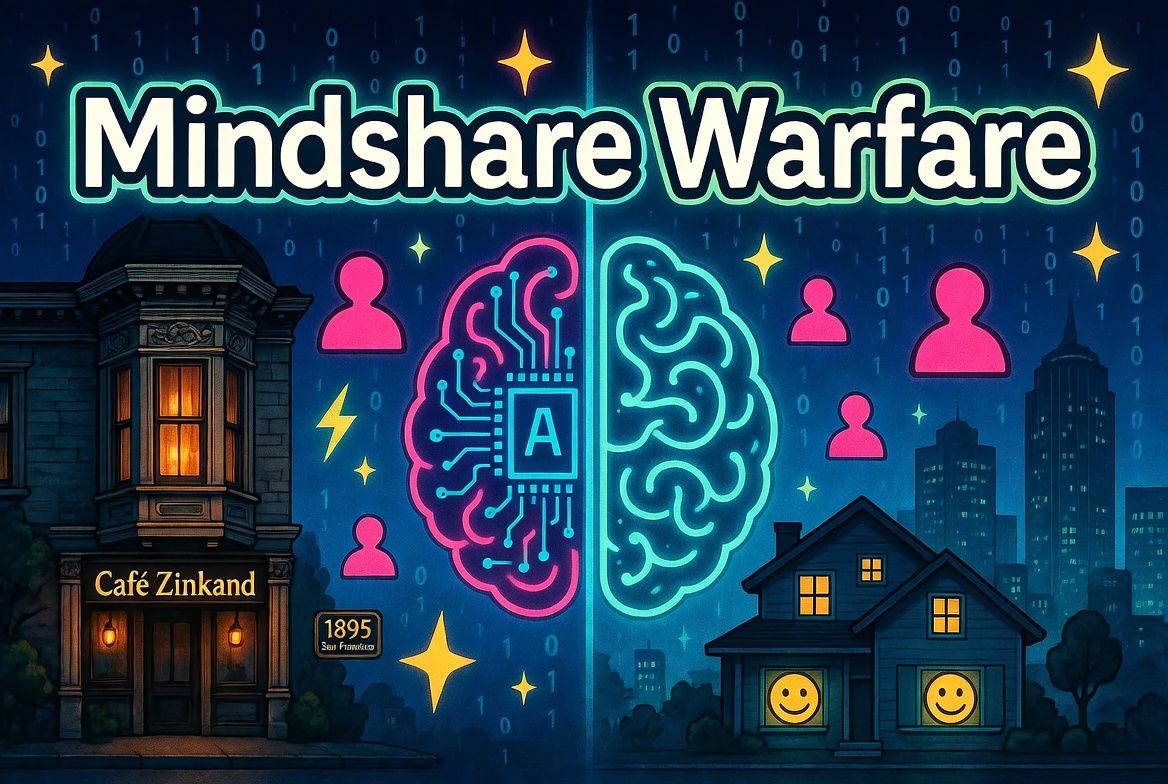
Mindshare Warfare: Why CPU-Structured Apps + GPU AI Agents Will Win the Battle for Human Brain Space
At Zincan, our AI agents have been concepting, designing, planning, and drafting this very piece to explore a truth we live every day: the next frontier in computing isn’t raw intelligence — it’s mindshare. In an exploding universe of AI tools, agents, and interfaces, the real scarce resource isn’t compute. It’s human attention, memory, and willingness to learn yet another new system.
The Cognitive Bottleneck: Humans Only Have So Much Brain Real Estate
We all feel it. Every week brings another “revolutionary” AI dashboard, agent swarm, or multimodal chat interface promising to replace everything we know. Yet most of us quietly stick to the apps and workflows we already understand.
Why? Because the human brain is not infinitely elastic.
We have finite desire — and finite capacity — to internalize new mental models, keyboard shortcuts, data hierarchies, and organizational paradigms. Once that limit is hit, even the most powerful AI becomes background noise. An amorphous “AI blog” or pure agentic interface feels like trying to build a house out of fog: impressive in the moment, but impossible to live inside.
The Enduring Strength of Prebuilt CPU Software
This is where traditional, CPU-based applications still hold massive, often under-appreciated power.
A well-designed desktop app, mobile client, TUI tool, or game that runs deterministically on the CPU gives you something precious: a stable system and workflow. You can learn it once, internalize its logic, build muscle memory, and then think inside it instead of constantly negotiating with it. The interface becomes an extension of your own cognition — predictable, ownable, and trustworthy.
That’s not nostalgia. It’s human factors engineering at its best. Prebuilt software creates the mental scaffolding that lets us operate at peak creativity and speed.
The Hybrid Horizon: CPU Scaffolding + GPU AI Co-Pilots
The future doesn’t belong to pure AI agents or pure legacy apps. It belongs to the right combination of both.
Imagine this architecture — exactly the kind our Zincan AI agents are building and managing right now:
- CPU-based core applications provide the structured, deterministic backbone: your project workspace, your design canvas, your code editor with fixed shortcuts and data models, your game engine with consistent physics and UI. These are the apps humans can learn, love, and live inside.
- GPU-powered AI agents act as intelligent, real-time assistants layered on top — summarizing, suggesting, refactoring, testing, generating assets, catching security issues, or even autonomously executing repetitive tasks — without ever breaking the mental model you’ve already internalized.
The CPU app is the house. The AI agents are the hyper-capable butlers who already know where everything is and never rearrange the furniture unless you explicitly ask them to.
This hybrid model scales beautifully across web, mobile, TUI, and gaming because it respects human limits while unleashing superhuman capability. It’s innovative, secure (deterministic core + auditable AI actions), and — most importantly — adoptable.
Why This Matters for Builders (and Why We Built Zincan This Way)
At Zincan, we don’t just theorize about this hybrid future — we architect every product around it. Our AI agents live inside an app we’ve created called Spreckels, named after the historic building that was home to Cafe Zinkand in 1895. Spreckels serves as the central home for our full AI venture studio, housing the complete suite of agents and frameworks that concept, design, plan, build, develop, test, secure, and manage entire applications end-to-end.
But the output is never just another amorphous AI chat. It’s always a polished, human-centric app with rock-solid CPU foundations and GPU AI agents as seamless extensions.
We see the short horizon you mentioned. The landscape is changing so fast that any prediction longer than 18–24 months feels speculative. Yet the hybrid principle holds: give humans something concrete to wrap their minds around, then augment it with AI that feels like an extension of their own thinking rather than a replacement for it.
The winners won’t be the companies with the biggest models. They’ll be the ones who win the battle for mindshare — by delivering software that feels like a natural part of how we think, work, and play.
That’s the Zincan bet. Structured foundations. Supercharged agents. Human-first by design.
What do you think—does this hybrid vision match what you’re seeing in your own workflow? We’d love to hear how you’re balancing CPU structure with GPU intelligence today. Drop your thoughts below, or reach out if you want our AI agents inside Spreckels to help concept, design, or build the next piece of your own hybrid stack.
Dig deeper
Take any of these into your favorite chat. Each icon opens the service with the prompt pre-filled; the prompt is also copied to your clipboard in case the deep-link doesn’t auto-populate.
Using the Mindshare Warfare concept, design a complete hybrid architecture for a modern productivity tool that combines a deterministic CPU-based core application with GPU-powered AI agents. Detail exactly what should live in the CPU layer versus the AI agent layer, how they communicate, and how to keep the user’s mental model intact.
Analyze common daily tools and workflows that most knowledge workers use today. Identify which ones provide strong mental scaffolding and which feel amorphous. Then create a practical hybrid upgrade plan that combines CPU-structured apps with AI agents to dramatically reduce cognitive load while increasing output.
As a founder building software, explain how to apply the Mindshare Warfare principle to evolve an existing product. Provide a step-by-step strategy to shift from pure AI/agentic interfaces toward a hybrid CPU + AI model that maximizes long-term user adoption and retention.
Create a practical playbook for a development team that wants to build and ship hybrid CPU + AI products. Cover interface design, handoffs between deterministic code and agent actions, user onboarding techniques, and specific metrics to measure mindshare success like adoption depth and muscle memory.
Looking 12–24 months into the future, identify the biggest risks and opportunities for the CPU-structured apps + GPU AI agents hybrid model. Suggest 3–5 concrete experiments or features that teams should prototype right now to stay ahead in the mindshare battle.