Will AI Take Over All Software?
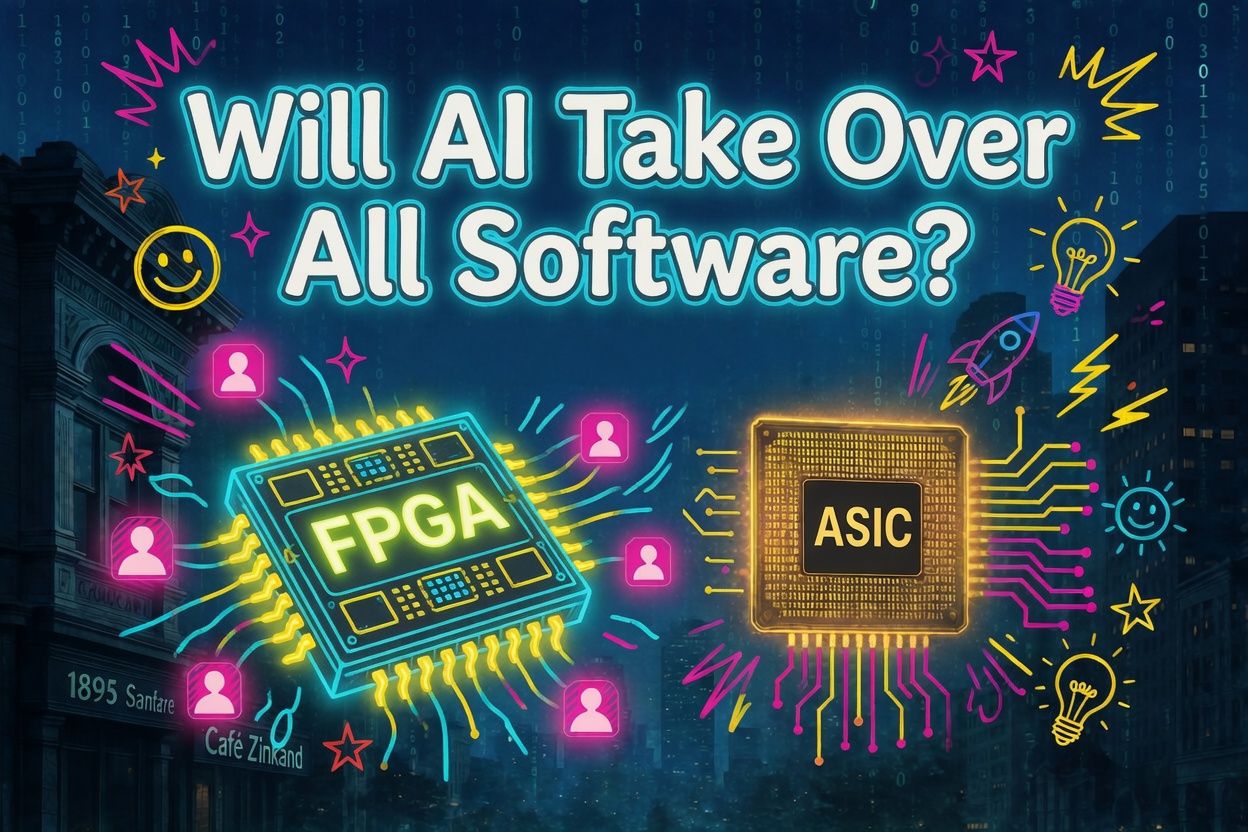
Why Purpose-Built, CPU-Efficient Apps Will Still Dominate the Next Decade
The headlines scream it daily: “AI will replace every coder.” “Every app will soon be just a prompt away.”
At Zincan, inside Spreckels — our AI venture studio named after the historic Spreckels building in San Francisco that housed Café Zinkand back in 1895 — we run dozens of specialized AI agents every single day. That same spirit of gathering, creativity, and bold ideas now powers the swarm of agents that concept, design, plan, build, develop, test, deploy, and manage production apps across web, mobile, TUI, and gaming platforms.
So we’re not here to downplay the revolution.
We’re here to say the revolution isn’t what most people think it is.
Large language models and multimodal agents are incredible at rapidly generating ideas, code, and entire features. But running everything through AI inference is like using an FPGA for every task in hardware: incredibly flexible and fast to prototype, but expensive and power-hungry at scale.
The Hardware Analogy That Actually Holds Up
In chip design:
- FPGAs are programmable — you can reconfigure them quickly and cheaply upfront. Great for experimentation and low-volume production.
- ASICs require deep specialization, time, and money to design, but once built they deliver dramatically lower power consumption, cost per operation, and latency for their specific purpose.
Modern software faces the exact same tradeoff.
Running every user request through a large AI model is the FPGA approach: flexible and magical for building, but costly to operate at scale. A well-architected, purpose-driven application — carefully designed and optimized — is the ASIC equivalent. It runs efficiently on commodity CPUs (or lightweight edge devices), consuming pennies instead of dollars per million requests while delivering predictable, blazing-fast performance.
The exciting part? AI dramatically lowers the barrier to creating these “ASIC-like” software systems. What used to take months of manual engineering now takes days with our agent swarm. We can rapidly explore, prototype, and then harden the final runtime for maximum efficiency.
We’ve seen this pattern play out inside Spreckels again and again. Our AI agents can spin up a complex feature in hours. Then our optimization agents step in — code architects, performance profilers, security auditors, and deployment strategists — turning it into production code that’s often 10–50× cheaper to run than the pure AI version.
Where AI Agents Shine vs. Where CPU-Native Wins
| Use Case | AI-Agent Heavy Approach | Purpose-Built CPU-Native Approach | Winner for Scale & Cost (2026–2030) |
|---|---|---|---|
| Creative generation (copy, images, UI ideas) | Native strength | Overkill | AI Agents |
| Real-time gaming physics / input handling | Possible but costly | Native engine code | CPU-Native |
| High-frequency trading / low-latency APIs | Latency penalty from inference | Sub-millisecond deterministic code | CPU-Native |
| Mobile apps on battery-constrained devices | Heavy battery drain | Lightweight native + selective AI calls | CPU-Native + selective agents |
| Enterprise CRUD + compliance workflows | Works, but audit trails are fuzzy | Deterministic, auditable, cheap | CPU-Native |
| Personalized recommendations (Netflix-style) | Excellent | Still needs heavy pre-computation | Hybrid |
The pattern is clear: AI agents are unbeatable at building and evolving software quickly and creatively. They are not always the best choice for running it at massive scale.
How Spreckels Powers the Future
This philosophy lives at the heart of Spreckels. Our AI agents don’t just write software — they concept, design, plan, build, develop, and manage every piece of the product with efficiency in mind from day one.
The result? Applications that feel magically intelligent to the end user (thanks to selective, high-value AI calls) yet run at a fraction of the cost and power of pure model-chaining architectures.
We’ve shipped web apps, mobile experiences, TUI tools, and real-time multiplayer games this way. In every case the final production footprint is dramatically smaller, more secure, and cheaper than a “let’s route everything through AI” approach.
The Foreseeable Future Isn’t “AI or Traditional”—It’s “AI Builds, Traditional Runs”
Model efficiency keeps improving, but user scale and expectations grow even faster. AI’s greatest gift isn’t replacing efficient software — it’s making efficient, purpose-built software radically easier and faster to create than ever before.
For the next 5–10 years, the winning products will use AI agents to do what they do best (rapid ideation and iteration) while ruthlessly optimizing the runtime for commodity hardware. That’s not resisting the AI revolution. That’s mastering it.
At Zincan, every line of code we ship is the result of this philosophy, all orchestrated inside the historic walls of Spreckels.
If you’re building something ambitious and want it to feel magically intelligent and run sustainably cheap, we should talk.
The ASIC of your next product is waiting to be designed — by agents that know exactly how to make it sing on CPUs.
Dig deeper
Take any of these into your favorite chat. Each icon opens the service with the prompt pre-filled; the prompt is also copied to your clipboard in case the deep-link doesn’t auto-populate.
Create a detailed beginner-friendly guide explaining the real-world tradeoffs between FPGAs and ASICs, using modern examples from AI hardware, gaming consoles, and mobile chips. Include cost, power consumption, development time, and flexibility comparisons with simple analogies and a decision flowchart.
Write a practical 2026 guide for developers on how to take AI-generated code (from tools like Claude or Grok) and transform it into highly efficient, production-ready CPU-native code. Include specific techniques for profiling, optimization, memory management, and when to keep small AI calls versus going fully native.
Explain how to architect a hybrid software application that uses AI agents for creative and complex tasks while keeping the core runtime on lightweight, efficient CPU code. Provide a real-world architecture diagram description, tech stack recommendations, and cost-saving examples for web, mobile, and backend services.
Compare the true operational costs (in 2026) of running a popular app entirely through AI inference versus a well-optimized native version. Break down per-user costs, latency, scalability, carbon footprint, and include a calculator-style formula developers can use.
Design a complete system prompt I can use with my ai agent to act as my personal "Zincan-style AI venture studio agent" — one that can concept, design, plan, build, and optimize full-stack applications with strong emphasis on runtime efficiency and cost-effectiveness.
Write an in-depth exploration of how software architecture will likely evolve between 2026 and 2035, focusing on the balance between AI-generated flexible systems and purpose-built efficient runtimes. Include predictions, risks, and winning strategies for indie developers and startups.
Give me a step-by-step playbook for a solo founder or small team to build their next SaaS product using AI agents for 80% of the work while ensuring the final product runs cheaply and performs blazing fast on regular servers or edge devices.